【Nose Electric Railway】A Scenic Journey into Japan’s Hidden Countryside


【Index】
【Executive Summary】
Noseden (Nose Electric Railway) is a charming local railway linking suburban Osaka to the scenic Hokusetsu countryside around Kawanishi, Toyono, Nose, and Inagawa.
The line offers tourists a relaxed journey through terraced rice fields, satoyama forests and mountain foothills around 1 hour north of Osaka.
Along the way passengers can visit historic shrines, sample regional foods (wild boar, chestnuts) and enjoy seasonal views – from cherry blossoms in spring to hydrangeas and fireflies in June, and brilliant autumn foliage.
Noseden operates two lines – the Myōken Line (Kawanishi-Noseguchi to Myōkenguchi) and the Nissei Line (branching at Yamashita to Nissei-chūō) – with frequent local trains and vintage Hankyū-derived rolling stock.
Stations and route maps are bilingual, IC cards (Suica/PiTaPa etc.) are accepted, and major stations are accessible (elevators, ramps, accessible restrooms).
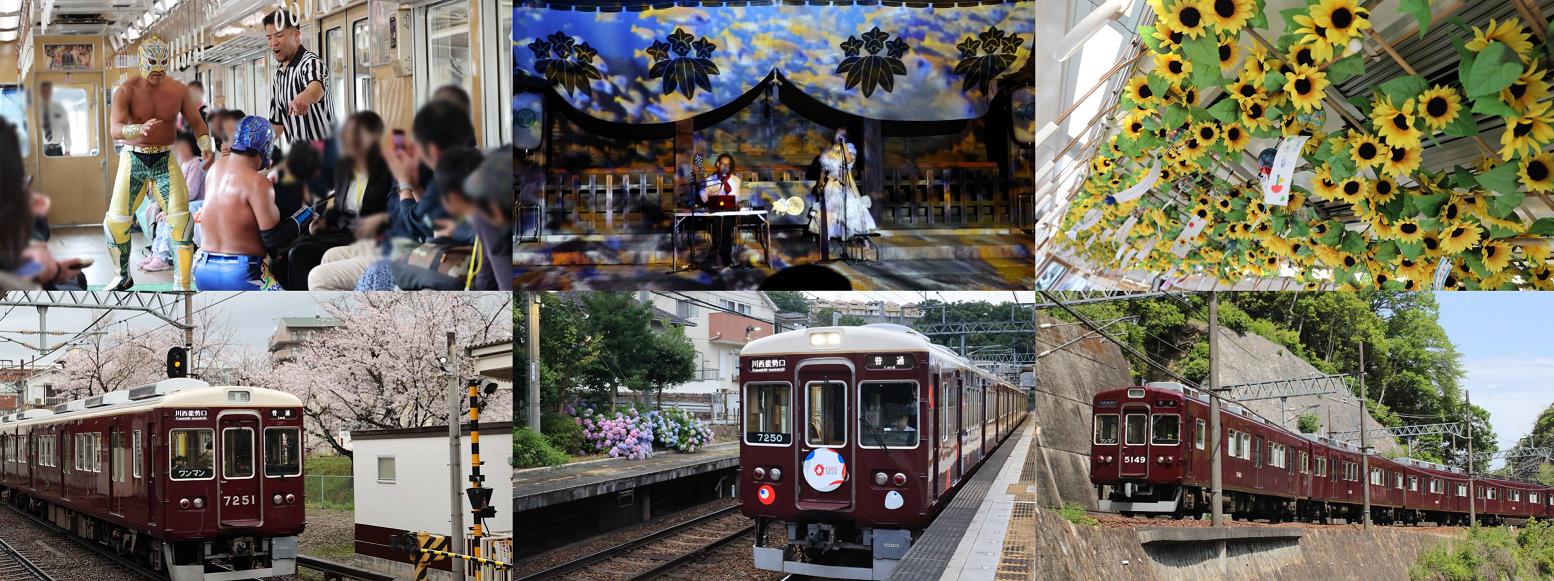
Unique experiences include riding the nostalgic 1700-series trains, seasonal decorated “wind-chime" summer trains and quirky event trains (e.g. a Pro-Wrestling themed train and a “graduation blessing" train).
Nearby attractions include Mt.Myōken (Nose Myōken-san Temple, a 1,200-year-old North Star temple on a 660m peak), the historic Tada Shrine (genji-clan heritage), local farms and riverside hiking.
Visitors from Umeda/Osaka can reach Nose via Hankyū trains (about 20min) to Kawanishi-Noseguchi, then transfer to Noseden for the countryside adventure.
This guide details Noseden’s history, routes, highlights, itineraries, practical tips and more to help international travelers plan a memorable day trip on this “other side" of Osaka.
【History and Heritage】
Noseden is a century-old private railway (originating in 1908) that opened its first section (Kawanishi-Noseguchi to Ichinotorii) in 1913 and extended to Myōkenguchi by 1923.
It became part of the Hankyū group and has long served rural north-Osaka.
The line was originally electrified at 600 V DC; in 1995 it was upgraded to 1500 V.
For decades Noseden operated the “Myōken-no-Mori" cable car and chairlift up Mt.Myōken, serving visitors to the ancient Nose Myōken-san Temple.
(These “Nose Myōken Forest" ropeway services were closed in 2023 due to low ridership and ageing equipment.)
The cultural heritage persists: at the top of Mt.Myōken (660 m) sits a Nichiren sect temple (Nose Myōken-san) enshrining the North Star deity (Myōken Daibosatsu), said to date back 1200 years.
Nearby towns along Noseden preserve Edo-period shrines and samurai-era sites from the Seiwa Genji lineage.
The overall vibe is one of “Satoyama history" – old farm villages and temples framed by rice terraces and oak forests.
【Lines, Stations and Scenic Routes】
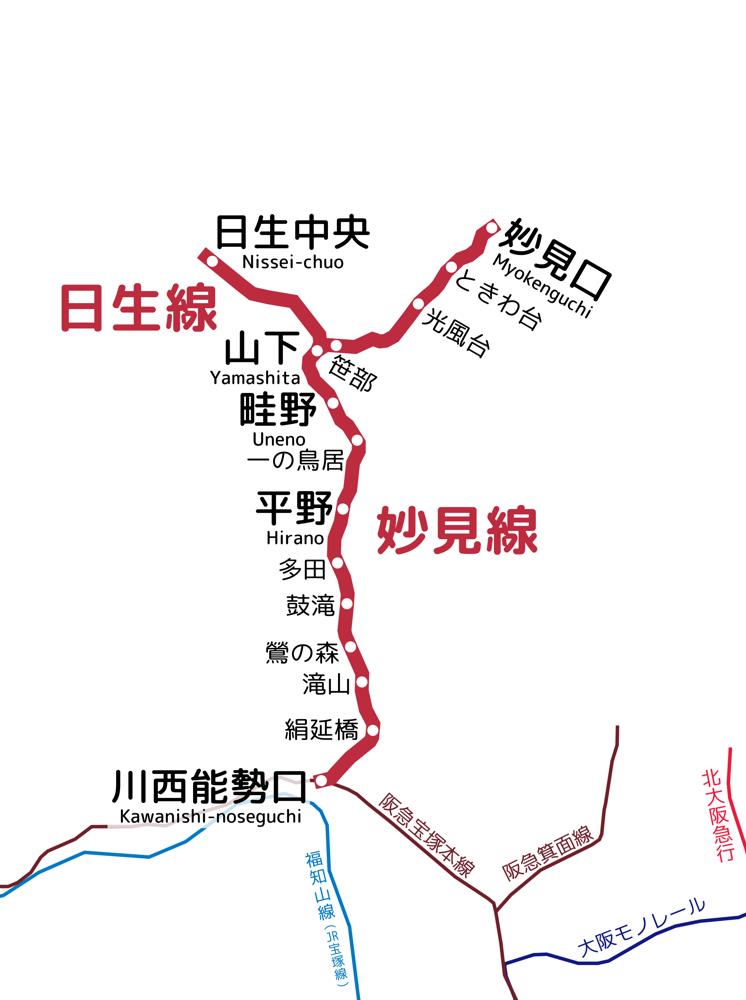
Noseden has two lines:
- Myōken Line (Main Line):
- runs 12.2 km from Kawanishi-Noseguchi (NS01) to Myōkenguchi (NS14) via 14 stops (e.g. Tada, Yamashita).
- This line climbs into the mountains; after Yamashita (8.2 km) the rail winds through wooded valleys to Myōkenguchi at the base of Mt.Myōken.
- Scenic highlights include riverside farmland and hillside oak forests – in spring the Edohigan cherry trees and rape blossoms bloom along the route.
- Nissei Line (Branch Line):
- branches from Yamashita (NS10) to Nissei-chūō (NS21) for 2.6 km (2 stops).
- This branch serves a suburban newtown (Nissei Newtown) and connects to Inagawa’s rural areas.
Each station is modest, but key stops have attractions.
Tada (NS06) is the gateway to Tada Shrine (a major Genji clan historic shrine).
Myōkenguchi (NS14) is the trailhead to Mt. Myōken.
The map above shows the full network.
All trains are locals (stopping at every station) and run roughly every 10 minutes.
A few “Nissei Express" runs (weekday peak) go direct from Umeda through Nissei-chuo.
Platforms and train signage have English names, making navigation easy for tourists.
【Signature Experiences】
Riding Noseden is an experience in itself.
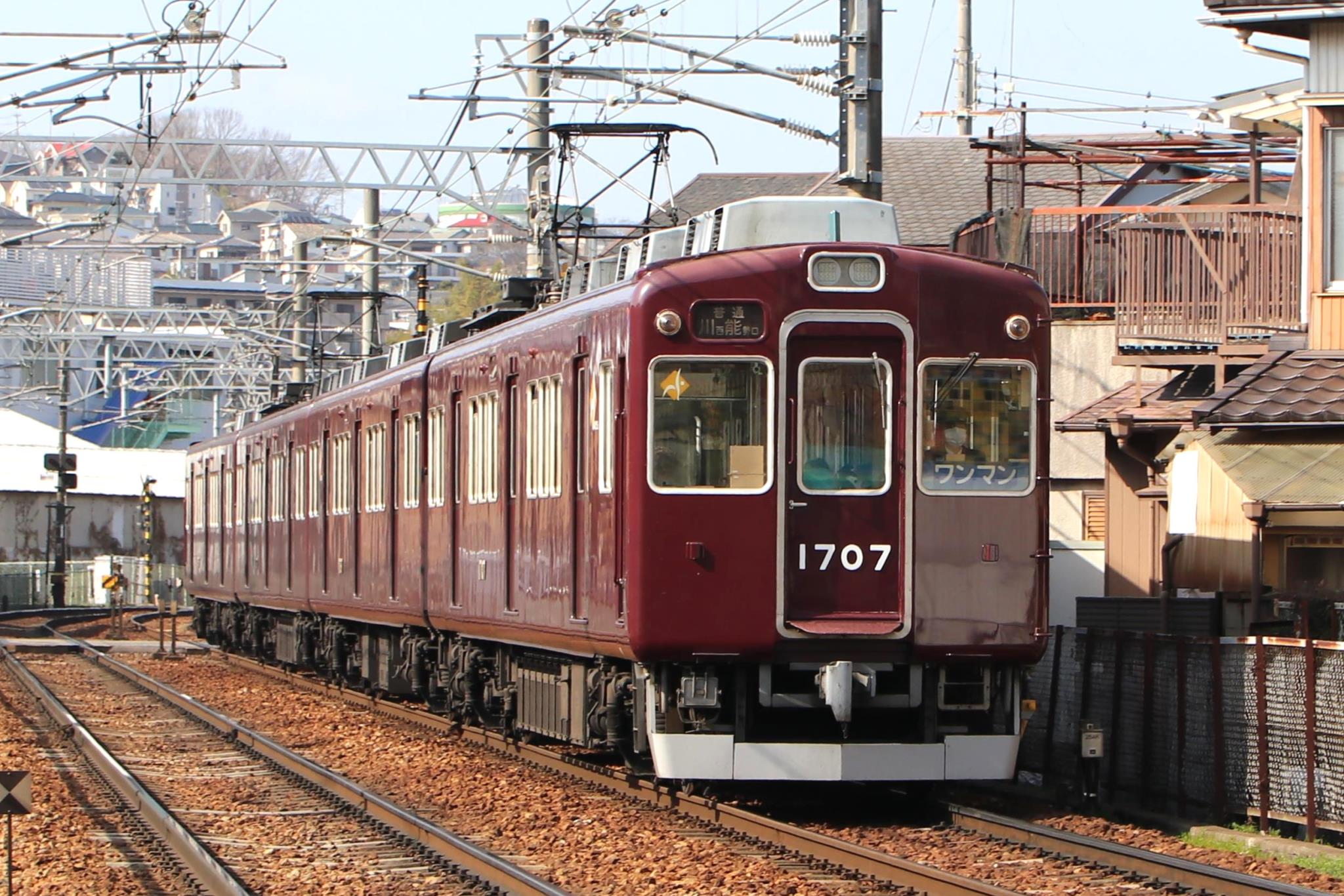
The vintage EMUs – mostly ex-Hankyū 2 or 4car sets (e.g. 1700, 5100, 7200 series) – give the ride a nostalgic feel.
Each car is air-conditioned, with large windows for viewing the countryside.
Special decorative trains add to the fun: every summer Noseden runs a “Wind-Chime Train" decorated with sunflowers and colorful furin glass chimes.
There are also seasonal “festive" trains, such as a Pro-Wrestling themed train and a “Graduation Tribute” train in February–March.
These themed services are unique to Noseden and beloved by locals, making each ride memorable.
Bottom row: Cherry blossoms, hydrangeas, rural mountain scenery
Another highlight is the scenic route itself.
In spring the Edohigan cherry trees along the tracks (a protected natural monument) burst into blossom.
June brings lush greenery and blooming hydrangeas by Uguisunomori station, and you may glimpse fireflies after dark along the River.
Fall colors come later here than in southern Osaka, often peaking in mid-November with vivid scarlets and golds on the hillsides.
Even without events, simply watching the train go by at a rural crossing or from the open fields is a photographer’s delight.
【Practical Information】(Access, Fares, Passes, Language, Accessibility)
- Access:
- From Osaka/Umeda, take the Hankyū Takarazuka Line to Kawanishi-Noseguchi Station.
- This takes ~20–25 min by Express (28 min Local).
- At Kawanishi-Noseguchi you can transfer easily to Noseden.
- Noseden’s first trains usually start around 5–6 am and last trains depart late evening; schedules are on the Noseden site. (There is no JR line serving Nose.)
- Fares & Tickets:
- Noseden fares are distance-based: e.g. one-way Kawanishi-Noseguchi→Myōkenguchi is around ¥360.
- You can simply use a prepaid IC card (Suica/PiTaPa/etc.), as Noseden joined the nationwide IC network.
- Although there are no JR passes available on the Nose Electric Railway, we do sell QR digital one-day tickets that allow you to ride on all Nose Electric Railway lines.
- Timetables:
- Noseden trains run roughly every 10 minutes on each line.
- Local trains stop at all stations.There are a few “Nissei Express" trains (Limited Express) that run only between Nissei-chūō and Kawanishi-Noseguchi during weekday rush hours.
- Hankyū trains to Kawanishi-Noseguchi leave Umeda frequently (every 5–10 minutes in peak).
- Always consult the latest timetables on the Noseden official website (railway section) before traveling.
- Language & Signage:
- Station names and in-train displays are in Japanese and English.
- Most stations do not have station staff.
- Tourist maps (like the “Chottabi" Hokusetsu map) and local attraction signage may be in Japanese only, so carrying a map (or smartphone translator) can help.
- Accessibility:
- Major stations like Kawanishi-Noseguchi, Hirano and Nissei-chuo are equipped with elevators or escalators and have wheelchair-access restrooms.
- Many smaller stations have ramps or gentle slopes.
- Tactile (braille) maps and floor indicators are installed in key stations.
- Noseden aims to be barrier-free, but some tiny rural platforms may have steps.
- Contact Noseden ahead for assistance if needed.
- Safety & Etiquette:
- Noseden is a safe, family-friendly railway.
- Standard Japanese train manners apply: queue in line at marked spots, let passengers alight first, speak quietly, and refrain from eating or drinking on local trains (water is okay).
- Priority seats for elderly/disabled should be offered to those in need.
- Keep your bags on your lap or in overhead racks, not blocking aisles or seats.
- Mind the platform edge and the gap when boarding.
- Finally, enjoy the ride politely – locals appreciate respectful visitors.
(Noseden even runs periodic safety/etiquette campaigns, e.g. on proper luggage stowage.)
【Unique Selling Points】
Noseden’s uniqueness lies in its combination of easy access from Osaka and deep rural charm.
Within half an hour of downtown Osaka you can board a modest train and suddenly find yourself amid mountain rice fields and village temples – a contrast to the urban bustle.
Unlike larger tourist lines, Noseden still feels like a community shuttle.
It offers a slice of authentic Japan that few Kansai railways provide (aside from some Wakayama forest lines).
Its decorative trains and local festivals (e.g. pro-wrestling train, beer-train, wind-chime train) are quirky and fun – a “small-scale Disneyland" of trains that even many Japanese visitors enjoy.
Furthermore, Noseden connects to attractions (Nose Myōken, Tada Shrine) that have no railway access except via Noseden, making it the key to exploring Osaka’s “hidden north”.
In short, for travelers seeking real countryside and culture just beyond Osaka, Noseden is unmatched.
【Suggested Sources to Cite】
For authoritative information on Noseden and Nose-area tourism, the following official sources are recommended (prioritizing English or Japanese):
- Noseden Official Website
- railway info, news, timetables, fares (English section and Japanese).
- For example, station lists, IC cards accepted, barrier-free info, and event announcements.
- See especially “Railway Information" and “Odekake/Sightseeing" sections.
- Noseden “Hokusetsu Chottabi" Travel Guide
- Hankyū group’s Hokusetsu tourism site, English pages describing seasons, foods, sights along the line.
- Hankyū group’s Hokusetsu tourism site, English pages describing seasons, foods, sights along the line.
- Osaka Prefecture / City Tourism
- e.g. Nose Myōken-san temple overview and regional itineraries.
- e.g. Nose Myōken-san temple overview and regional itineraries.
- A Weekend Trip into Osaka’s Unknown North
<About This Website>
Welcome to NOSÉ KNITs !!
This website delivers a wide range of information about the Nose Electric Railway (Noseden),
and the areas along its route (Kawanishi, Inagawa, Nose, and Toyono) with the kind of relaxed,
laid-back vibe you’d find in knitting (KNIT), covering even the most niche topics.
If you have any requests for research on railways or local information,
or for translations of Japanese-language articles,
please let us know in the comments.
- 【NOSÉ KNITs】English Front Page
- List of Articles (English Version)
- List of English Translations of Japanese Article Titles
(NOSE KNITs – Website cheering the Nosé Electric Railway and Its Surrounding Areas!)

Random Post Display Button